
On Thursday night the Washington Capitals lost 3-2 to the Seattle Kraken. It was a weird game. The Capitals got pummeled in shot attempts (63-29) but never trailed in the actual game until overtime where they lost in seven seconds.
The player usage was weird as well. Conor Sheary, on ice for 24 Seattle attempts and 10 Washington attempts during five-on-five, played 18:51, a high among forwards. Meanwhile, Anthony Mantha played a team-low of 10:40 (all strengths). During those 15 shifts, the Caps had their best on-ice expected goals percentage (56.8 percent).
Mantha’s low usage comes one game after he made a high-level carry-in and pass to help Alex Ovechkin score his second goal of the night against the Vancouver Canucks.
Getting acquainted with goalie victim No. 165 pic.twitter.com/kpGr0NFMcO
— Washington Capitals (@Capitals) November 30, 2022
One game can’t tell the full story for any player, but Thursday’s low ice time certainly raises eyebrows. The Seattle game was Mantha’s lowest ice time of the season by more than a minute. His suspect usage gets even more conspicuous considering how many top-six forwards are out due to injury, and Mantha’s own high-profile acquisition from the Detroit Red Wings in exchange for a supposed top-sixer, Jakub Vrana. As the fifth highest-paid forward on the Capitals, Mantha feels like he should be a leading forward. And with his sterling underlying play, you could argue he deserves more opportunity, a case made well by Luke Adomanis over at Japers Rink.
Despite his top-six bona fides and the team’s glaring holes in those same spots, Mantha has spent the last month skating on a defensively deployed third line. He has started only 46 percent of his not-on-the-fly zone starts in the offensive zone, down from 53 percent last year. Here, from HockeyViz, are zone starts this season. Red over black means more defensive zone starts.
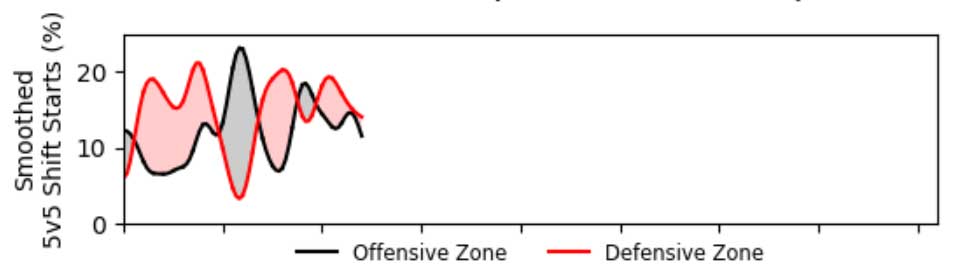
And Mantha is hardly playing special teams. Eight skaters have received more power-play minutes than he has (32:45). He’s played under a minute of the penalty kill. So it’s all happening at five-on-five, where Mantha’s most common linemate is Lars Eller. They have not been successful. Opponents have outscored the Capitals 12 to 6 in their 180 minutes together — though it’s worth noting that the save percentage when they’re on the ice is .867.
Beneath the scoreboard, Mantha’s record is clearer and stronger. The team’s expected-goals percentage increases five points when he takes shifts, second highest on the team behind only Aliaksei Protas. Among forwards, only Ovechkin and Kuznetsov have seen their on-ice shot-attempt percentage drop when paired with Mantha. HockeyViz estimates that Mantha has improved Washington’s offense by four percentage points and their defense by six percentage points.
Individually, Mantha’s offense rates remain strong: just under one goal per hour, an individual expected-goal rate that has ticked up slightly, and a solid shooting percentage. His linemates have fared worse, shooting just seven percent, missing their expected goal count by about four (i.e. six non-Mantha goals on 10 non-Mantha expected goals). That’s an aberration — especially for a strong “setting” player like Mantha — and when combined with the second worst on-ice goaltending among Caps forwards, it explains a good amount of Mantha’s season. One has to wonder if that’s why we’re not seeing him in the top six more often.
In his limited time on the top line, Mantha didn’t immediately click with Ovechkin and Kuznetsov. The Caps controlled just 36.4 percent of expected goals in those mere 16 minutes as a trio.
| On ice | TOI | WSH goals | Opp goals | SA% | xGF% |
|---|---|---|---|---|---|
| Ovechkin Kuznetsov Mantha | 16 | 0 | 0 | 46.2 | 36.4 |
| Mantha + 92 | 41 | 2 | 0 | 52.4 | 64.7 |
| Mantha + 8 | 23 | 1 | 3 | 48.9 | 52.0 |
| Mantha away from 8+92 | 241 | 8 | 13 | 52.3 | 51.8 |
| 8+92 away from Mantha | 133 | 7 | 7 | 58.8 | 53.5 |
Ovechkin now skates with Dylan Strome and Conor Sheary. Since returning from injury, TJ Oshie has filled out the second line with Sonny Milano and Evgeny Kuznetsov. That leaves Mantha stuck on the wing of the third line. Mantha’s been in that role for a month now, ostensibly to help Washington’s scuffed team defense: they have surrendered the fourth-most five-on-five goals (48) in the Eastern Conference. That role may also buttress Lars Eller, who is 33, not the strongest skater, and in the final season of his contract. Mantha in bottom six further gives Laviolette a second line that can play in a defensive stance, a luxury he did not have in the two seasons prior when he used the third line to shelter younger players. Nic Dowd and Garnet Hathaway have been exclusively used as the shutdown line during Laviolette’s tenure.
There may be a lot of reasons why Mantha is skating on the third line, but it doesn’t explain why he saw so little action against the Kraken on Thursday. It’s a dark portent for the Capitals, who would certainly want their 28-year-old forward to become a star scorer and take pressure off Alex Ovechkin. The Caps gave up a lot to acquire Mantha, so it’s discouraging to see him stuck in the same place Jakub Vrana was.
Headline photo: Alan Dobbins/RMNB


