
Photo: Scott Rovak
When the Caps were losing games early in the season, it wasn’t a big deal. The Capitals were playing well when you measured their shot-attempt differential, but the goalies were letting in too many goals. Because goalies’ cumulative save percentages are extremely volatile early in the season, and because Braden Holtby’s career save percentage is pretty high, there wasn’t much cause for concern.
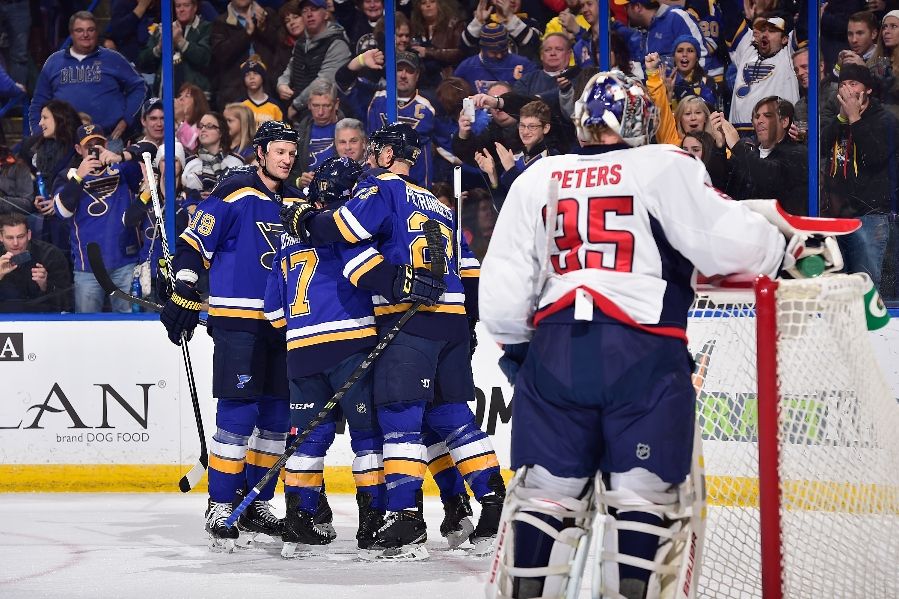
Now, after deflating losses to the Blues and Devils– both great possession teams– the Capitals’ possession seems to have eroded a bit. The goaltending, at least Holtby’s 96.4-percent effort on Friday, hasn’t been bad since early November. The problem now is that the Capitals can’t do the thing crucial to winning games: score goals.
You can chalk it up to urgency, and to some extent I do, but there is also mounting evidence that the Capitals are failing to optimize their offense. That’s the topic of this week’s snapshot.
Previous snapshots: week 1, week 2, week 3, week 4
Let’s do the numbers. These are current as of noon on Sunday, November 16th– but the Blues game is not included yet. The sample is restricted to 5v5 hockey when the score is close. That means the score is within one goal in the first two periods and tied in the third. There’s a glossary at bottom with an explanatory video.
Forwards
| Player | GP | TOI | SA% | Goal% | PDO | ZS% |
| Latta | 13 | 61.2 | 61.3 | 100 | 105.3 | 44.8 |
| Ovechkin | 16 | 159.7 | 58.7 | 53.9 | 98.9 | 58.3 |
| Fehr | 13 | 115.6 | 56.3 | 83.3 | 107.6 | 47.5 |
| Ward | 16 | 134.7 | 57.8 | 55.6 | 100.2 | 53.9 |
| Backstrom | 16 | 160.0 | 55.8 | 46.2 | 97.3 | 54.2 |
| Burakovsky | 16 | 119.5 | 55.6 | 57.1 | 101.0 | 68.3 |
| Kuznetsov | 15 | 87.9 | 52.4 | 66.7 | 103.7 | 54.4 |
| Johansson | 16 | 120.8 | 53.0 | 50.0 | 98.7 | 62.3 |
| Beagle | 11 | 72.8 | 52.7 | 60.0 | 102.2 | 48.7 |
| Brouwer | 16 | 124.0 | 51.6 | 50.0 | 99.2 | 63.9 |
| Wilson | 5 | 48.5 | 50.0 | 33.3 | 88.7 | 59.4 |
| Chimera | 16 | 123.2 | 48.2 | 50.0 | 100.3 | 50.6 |
Defense
| Player | GP | TOI | SA% | Goal% | PDO | ZS% |
| Green | 15 | 115.9 | 60.1 | 66.7 | 102.8 | 61.8 |
| Schmidt | 16 | 111.9 | 57.5 | 76.9 | 108.4 | 53.4 |
| Niskanen | 16 | 142.7 | 52.2 | 46.7 | 98.1 | 59.3 |
| Carlson | 16 | 140.7 | 51.2 | 53.9 | 101.4 | 51.7 |
| Orpik | 16 | 154.0 | 51.5 | 46.2 | 95.7 | 57.4 |
| Alzner | 16 | 130.0 | 51.1 | 38.5 | 95.7 | 55.7 |
Observations
- A note on methodology: There has been a lot of discussion and debate about expanding possession metrics to all game situations (and perhaps weighting the leading/trailing stuff differently). The stats in the tables above are close score only and I think they will remain so– if only just for consistency. That said, the peer review and iterative improvements to the way we do analysis is very welcome. Were I to start the snapshot over, I would expand to all 5v5 situations. And I might still do that, just not today.
- The Capitals dropped a percentage point in puck possession this week (using score-adjusted stats), and I think that’s important for us to process. Those games against the Devils and the Blues were aberrational, I hope. The scoring line was neutered for the presence of Jay Beagle versus the Devils, and the Capitals lacked urgency in St. Louis, particularly in their bottom six. Unlike games earlier in the season, when spotty goaltending cost a good team wins, the Capitals really and truly played bad hockey this weekend. That’s concerning– much more than fretting over goalies based on only 200 shots. I wonder what they’re doing wrong, and I have a few ideas.
- Alright, so get this: I picked a stable forward to represent each line and a D-man from each defensive pairing. I put the forward and the defenceman’s combined shot-attempt percentage (Corsi) in the cell and then I color-coded the cell based on the percentage of 5v5 ice time that forward spent with that defender. Green means the forward took a lot of shifts with that defender (40%+), red means less than 30%, yellows and oranges are in between.
| 1 Orpik | 2 Niskanen | 3 Green | |
| 1 Ovechkin | 47.9 | 55.6 | 62.6 |
| 2 Burakovsky | 50.5 | 57.6 | 57.5 |
| 3 Chimera | 41.4 | 46.8 | 55.3 |
| 4 Latta | 57.9 | 52.5 | 53.8 |
- Alex Ovechkin is destroying his opponents– except when paired with Brooks Orpik (47.9 percent of the shot attempts), presumably when going up against the opponent’s best players. But he’s spending a whopping 47.4 percent of his time with Orpik, during which the Caps have been outscored 7 to 2. Anyone who says Orpik is making Ovechkin better defensively is either wrong or lying.
- Jason Chimera is not playing good hockey; he’s the only player seeing under 50 percent of shot attempts (SA%). How he’s escaped Trotz’s doghouse seems to me to be more about the adjectives of his play (gritty, fast-paced, urgent) rather than the outcomes of his play (losing hockey games). A healthy scratch might do Chimmer well.
- Michael Latta‘s fourth line is getting a lot of ice time with Mike Green, but that’s not what’s driving Latta’s good possession. Surprisingly, Latta is killing it when with Orpik (57.9 percent of the shot attempts), which might indicate a number of things. Maybe those are the shifts when Orpik isn’t being used to shut down the opponent’s top line. Or maybe the fourth line’s corpus of tactics and skill set is a better match for Orpik and Carlson. This merits more investigation.
- Back to the Brooks Orpik thing: He is not a shutdown defenseman. He is being used as a shutdown defenseman, but he is not performing like one. Here are some consensus shutdown D from around the league: Suter, Giordano, Hjalmarsson, Chara, Tyutin, Mitchell, Bouwmeester, Hamonic, Weber. If you add Orpik to the list, he’s dead last in relative possession. He’s second-t0-last in absolute possession (poor Giordano), but he’s still seeing the fourth largest share of starts in the offensive zone, and the quality of his competition is only in the middle of the rankings. Check out the Vollman player usage chart from War on Ice.

- I don’t get Jay Beagle (who has the worst relative possession among regular players) on the top line– even if it was just temporary. I’m afraid to even try to understand it. I’m imagining a dartboard with a bunch of grinding forwards’ faces on it, and Barry Trotz blithely tossing a dart at it with a question in his mind: “Who should skate on Alex Ovechkin’s off-wing?” That’s scary, but it’d be preferable to “Hey, it worked for Adam Oates.”
- I wrote about how the Capitals should work on re-signing Mike Green two weeks ago. His performance on the ice is indisputable. But I tend to think in the world of “ought,” and I’m kind of bad at imagining the world of actual likelihood. Neil Greenberg did a great job on the Crashing the Net podcast explaining the perspectives of the team and the player and how that would factor into any negotiation or trade. Neil measures the gap between those perspectives in dollars: about two million of them.
Edited to add: Rob Vollman wrote a real good piece for ESPN about Green and his comparables. - This next conclusion is kind of counterintuitive. In order to better optimize the Capitals, they should reduce specialization. Maybe share the tough shifts and big minutes more equally among the three D pairings. Maximize the number of shifts that Alex Ovechkin shares with Mike Green, and minimize the number of shifts Jason Chimera takes, period.
- Goalies are saving just 88.9 percent of shots while Karl Alzner is on the ice within our sample. That’s the big driver of his low PDO and something I hope to see rebound soon.
- A final note on goalies. Braden Holtby saved 27 of 28 shots on Friday night. The one goal he let by was ridiculous, but his effort was still a quality start. A goalie who saves 96.4 or better wins the game 98 percent of the time (that’s some rough math by me; please feel free to correct me) [UPDATE: Revised math has it at 93.48 percent]. A team that scores no goals wins the game 0 percent of the time (I am sure about that). There are gonna be dumb-looking goals in hockey, and Holtby is gonna work on how he handles pucks behind the net, but it’s unwise to let those tangible details obscure a winsome performance from a goalie.
Glossary
- 5v5 Close. Our sample. The portions of games when each team has five skaters and the score is within one goal in the first two periods and tied during the third.
- GP. Games played.
- TOI. Time on ice. The amount of time that player played during 5v5 close.
- SA%. Shot-attempt percentage, a measurement for puck possession. The share of shot attempts that the player’s team got while he was on the ice. Also known as Fenwick. Above 50 percent is good.
- Goal%. Goal percentage. The share of goals that the player’s team got while he was on the ice. Above 50 percent is good.
- PDO. A meaningless acronym. The sum of a player’s on-ice shooting percentage and his goalies’ on-ice save percentage. Above 100 means the player is getting fortunate results that may reflected in goal%.
- ZS%. Offensive zone start percentage. Excluding neutral-zone starts, the share of shifts that the player starts in the offensive zone, nearer to the opponent’s net.
Thanks to War On Ice for the stats.


